
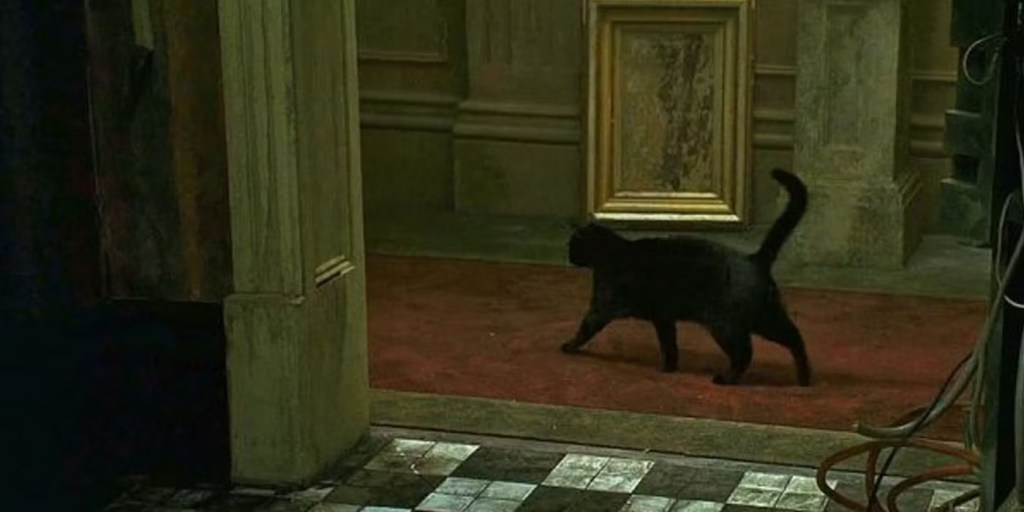
In The Matrix, there was a scene of a black cat walking across a doorway. Neo then sees the same cat walking across the doorway again. He whispers to himself, “Whoa! Deja vu!” Trinity then explains that a deja vu is usually a glitch in the Matrix, whereby something is changed in it. In this instance, it was a trap set by the “agents”. The Matrix is a movie full of philosophy and is perhaps also a commentary on our world as well.
Friedrich Nietzsche once said, “God is dead” and it succinctly summarizes the post-modern secular world’s beliefs. It is posited that nothing beyond the material word exists and anything spiritual is a figment of our imagination (i.e. Materialism). Religion, as it is commonly believed, is a way humans have tried to understand nature, before we invented the scientific method. With science, things that were previously a mystery are now illuminated. Humanity is now able to cast aside old superstitions. Since there is no evidence for the existence of God or the spiritual realm, it is therefore not true…Or is there?
In this series of posts, we will explore the glitches in our matrix, which is the world we live in. The glitches are instances that cannot be explained by science. In fact, these glitches are direct evidence that either our science is not advanced enough to explain them or that, in fact, there is indeed a spiritual realm. My hope is the examples I provide will cause you to question the validity of Materialism, that there is nothing that exists beyond atoms and molecules.
The Shroud of Turin

I will start with the Shroud of Turin. If the Shroud doesn’t blow you away, I don’t know what will!
From a young age, I was fascinated by the Shroud of Turin. It is purportedly the burial cloth of Christ. I didn’t know too much about it, but I do remember, in my teenage years, hearing that a bunch of scientists had determined that the Shroud was a fake, after they had carbon dated its origin to be from the 13th or 14th century A.D., which coincides with the date that the Shroud had appeared on the scene, so to speak. Well, that was very disappointing news.
Fast forward a couple of decades and the Shroud somehow returned to my consciousness. One of the best videos on this topic is an interview with Father Robert Spitzer, who is a Jesuit priest and scholar focused on connecting faith, science and reason. The interview is posted below. He also has an amazing website. Here are the summary points on the Shroud from that interview:
- the image of Jesus on the Shroud is a photographic negative image of our Lord. The linen cloth is obviously not photographically sensitive and film photography was invented in the 19th century, hundreds of years after the Shroud was made known publicly
- the image has 3D layering of the flesh and bone of Jesus
- the image conforms to the Gospel narrative, including the crown of thorns, and the spear wound at the side of Jesus, including the stain of both blood and pleural fluid (i.e. the blood and “water” that poured out of Jesus’ side). The angle of the spear wound is also 30 degrees upwards penetrating into Jesus’ body
- the abovementioned carbon dating was debunked by 4 different subsequent tests. The carbon dating test took a sample from a corner that was burnt and mended by nuns using a technique called invisible mending, violating the original testing protocol specifying the requirement of taking samples from 7 different places on the Shroud that was not controversial. Subsequent tests including a vanillin test, 2 spectroscopic analyses, and compressibility and breaking strength tests date the Shroud to have originated in 50 A.D. +/- 200 years with 96% confidence (see article here)
- the production of the image, by ultraviolet radiation hypothesis, would have required 6 to 8 billion Watts for 1/40 billionth of a second. Essentially, the body of Jesus radiated UV electromagnetic radiation that would have been more powerful than all UV lasers that are currently in existence in the world combined. We still do not have the ability to reproduce the image on the Shroud with today’s technology
- the blood stains contain human hemoglobin and has an AB blood type (remember this for later on)
- the crown of thorns was made from the thorns prevalent in Judea but not outside of that area
- the scourging marks on Jesus’ body were made by a Roman flagrum, which was much different in shape than any whip known by medieval forgers
- the wound on Jesus’ hand indicates that the nail went into the palm and out the wrist on the back, which provides the strength to hold the body up on the cross
- the blood stains on the face cloth of Oviedo, which is the purported face cloth used before Jesus’ burial, and was documented as having been kept in Oviedo, Spain since the 6th century, has over 120 points of congruence with the image of the face on the Shroud. Note that this is likely the face cloth noted in the resurrection narrative in the Gospel of John
What does this all mean? If it isn’t already obvious to you, it is that the Shroud contains such overwhelming evidence that it is very old, likely from the time of Jesus, and the image on it has an enormous amount of detail that are consistent with the Gospel narratives. Lastly, the image itself is a photographic negative that, to this day, no technology can reproduce. Either this burial cloth is indeed the burial cloth of Jesus of Nazareth, who was resurrected via an event that produced an immense amount of UV radiation, causing an image of his body to be imprinted on the cloth, or there was a civilization with such advanced technology 2000 years ago that they produced this burial cloth to fool us into believing the story of some nascent religious sect in an unimportant part of the Roman empire. I think you know where I stand!


Leave a Reply